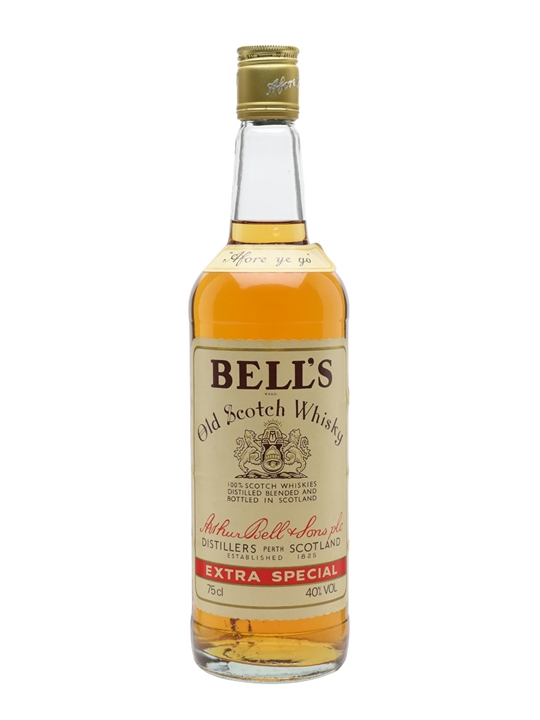

There's something almost archaeological about opening a bottle of Bell's Extra Special from the 1980s. Not because it's ancient — it isn't — but because it represents a snapshot of blended Scotch at a very specific moment in time. This was Bell's before Guinness completed its takeover of Arthur Bell & Sons, before Diageo existed as an entity, before the blended category got squeezed between single malt snobbery on one side and budget supermarket own-labels on the other. I spent a decade at Diageo, and I can tell you: the liquid in a 1980s Bell's bottle is not the same proposition as what sits on shelves today. The recipe, the component malts, the sherry cask availability — all of it was different.
Bell's Extra Special was, for a long stretch of the twentieth century, the best-selling whisky in the United Kingdom. Not the most glamorous. Not the most awarded. The best-selling. That distinction matters, because it tells you something about consistency and broad appeal. Arthur Bell & Sons built their reputation on a blend that worked — in a tumbler after work, in a hot toddy when Edinburgh turned bitter in January, alongside a Sunday roast. It was never trying to be cerebral. It was trying to be good.
Tasting Notes
I won't fabricate specific notes where the data doesn't support them, but I can speak to what a well-stored 1980s Bell's Extra Special typically delivers. At 40% ABV, this is bottled at standard strength, which was the norm for the era. What you should expect from a blend of this vintage is a rounder, slightly more sherried character than its modern equivalent. Component malts from the 1970s and early 1980s had greater access to quality refill sherry casks — a resource that has only become scarcer and more expensive since. The grain whisky component would have come from a smaller pool of operational grain distilleries, each with its own character. In short, this is a time capsule of how mainstream blended Scotch tasted when blended Scotch was king.
The Verdict
At £94.95, you're paying a premium over what Bell's costs today, obviously. But you're not buying today's Bell's. You're buying a piece of Scotch whisky's commercial history, bottled when the blend still carried a certain weight and when the name Arthur Bell still meant something on the label. For collectors, it's a fascinating reference point. For drinkers, it's genuinely enjoyable — a reminder that blended Scotch earned its dominance for a reason. A 7.7 out of 10 feels right. It's not going to compete with a well-aged single malt on complexity, but it was never supposed to. What it does, it does with quiet confidence and a warmth that feels earned rather than engineered. If you find one in good condition, it's worth the price.
Best Served
Pour it neat at room temperature, or with just a few drops of water. This deserves a moment of stillness — no ice, no mixers. A 1980s blend like this has had decades of slow interaction between liquid and glass, and you want to meet it on its own terms. A Glencairn or a simple tulip glass will do nicely. If you're feeling sociable, it pairs well with a slice of rich fruitcake or a square of dark chocolate. But honestly, the best companion for a bottle like this is a bit of quiet and someone who appreciates what they're drinking.