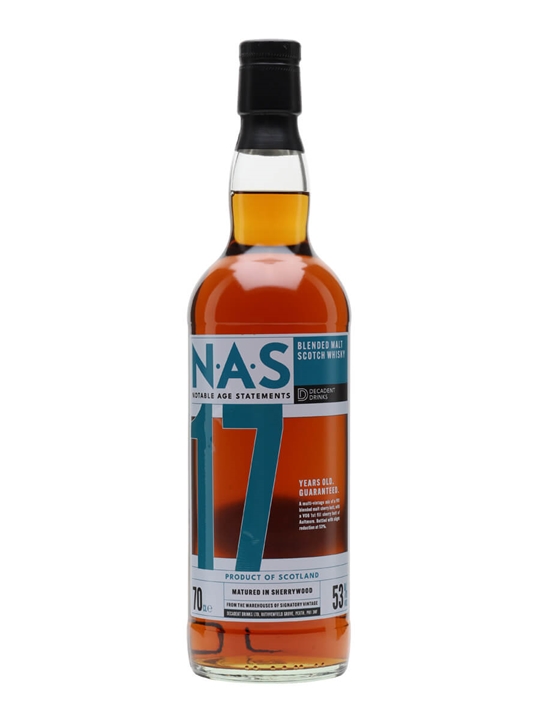

There's a quiet confidence to a blended malt that carries a 17-year age statement and bottles at 53% ABV. No single distillery name to lean on, no flashy marketing hook — just time in wood and whatever the blender decided was ready. I've spent enough years watching the Scotch industry operate to know that anonymous blended malts at this age and strength are often where the real value hides, assembled from parcels that didn't fit a single malt release schedule but were far too good to dump into a standard blend.
The Notable Age Statements series — the name itself is a dry bit of commentary on an industry that has spent the last decade trying to convince us age doesn't matter. At £97.50 for a 17-year-old malt whisky at cask strength, this is priced in a bracket that would barely buy you a 12-year-old single malt from any number of fashionable distilleries. That alone should get your attention.
What to Expect
Without a confirmed distillery source, we're in blind-tasting territory, which is honestly where blended malts deserve to be judged. At 17 years old, you're looking at whisky that has had proper time to develop complexity — the rough edges knocked off, the wood influence integrated rather than dominant. The 53% ABV tells you this hasn't been watered down to hit a commercial sweet spot. It's bottled with intent, at a strength that suggests the blender wanted the spirit's character to lead rather than retreat behind dilution.
Blended malts at this age tend to carry a depth that rewards patience. The interplay between different malt distilleries — potentially Highland, Speyside, or beyond — creates a layered profile that single malts can't replicate. You're tasting decisions, not just a single distillery's house style. That's the whole point.
The Verdict
I'm giving this a 7.9 out of 10. The age, the strength, and the price point all line up in a way that feels genuinely considered rather than commercially convenient. A 17-year-old malt whisky at natural strength for under a hundred quid is increasingly rare, and the fact that it arrives without a famous name on the label means you're paying for what's in the bottle rather than what's on it. That's a principle I can get behind.
Where it sits in the broader market is telling. The blended malt category has been quietly producing some of the most interesting Scotch whisky of the past few years, largely because it operates without the single malt segment's obsession with provenance and limited editions. This bottle won't generate queues outside whisky shops, which is precisely why it deserves your attention.
Best Served
Pour this neat in a Glencairn and give it ten minutes to open up — at 53%, it needs the air. If you find it a touch assertive, add water a few drops at a time until the spirit relaxes, but don't rush to dilute. Cask-strength whisky at 17 years old has earned the right to be met on its own terms. This would also hold up remarkably well alongside a board of hard cheese and oatcakes — the kind of straightforward pairing that actually works rather than just sounding impressive on a tasting menu.